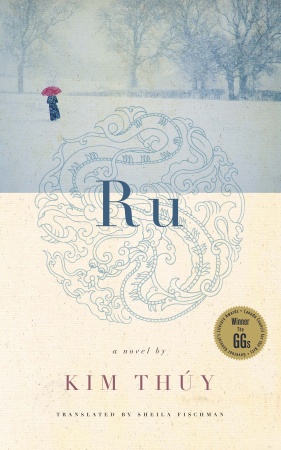
I’ll admit I was a little skeptical of Ru when I first read the excerpt on the
back cover: references to the Tet Offensive, the blood of soldiers, and lost
lives signaled a tragic and depressing story, and I wasn’t up for it. However,
this first novel by Kim Thuy won the Governor General’s Literary Award in 2010, among many other awards both
local and international, so I put first impressions aside and followed the advice
I’ve given many times never to judge a book by its cover.
What a relief to find a literary tour de force, so
powerful in its prose that each vignette flows seamlessly into the next,
leaving you eager for more. This remarkable fluidity is echoed in the title, Ru, which means lullaby in Vietnamese
and small stream in French. Originally composed in French and translated into
15 other languages, this novel is set in Saigon during the Vietnam War, a
refugee camp in Malaysia, and the promised land of Quebec. It loosely follows
Thuy’s own experience as a survivor and immigrant.
The structure is atypical for a novel; most of the
chapters are only one or two pages, each focusing on a different memory. In
some ways it reads like a long poem, each word chosen carefully for its distinct
meaning, vibrance, and delicacy. In other ways these chapters are like short,
cinematic scenes. Each one is a new lesson, a new insight into the subtleties
of human nature, based on the wisdom of someone who has witnessed the
disappearance of everything familiar and safe.
Amidst stories of loss and hardships are tales of hope,
unexpected generosities and love. There is a reverence for the people of Quebec
who welcome main character An Tinh with open arms, and there are reflections on
an animated past full of tradition in Saigon. There
are darker moments highlighted by the arrival of the Communist soldiers, the
poverty that leads to personal and physical sacrifice, and the lives wasted in
the carelessness of war.
Ru is a quick
read, too short in my opinion. I find Thuy’s powers of description addictive,
and will certainly give this book a second and third read. The novel has left
an indelible impression on me; I will not remember the details, but I will
remember Ru fondly as a novel that
brought me pure joy.
Click here for an interview with Kim Thuy where she talks about her experience in writing this novel.
Joan Didion is a prolific writer of the authentic
American experience. In university, I wrote my honours paper on Didion, so had
the opportunity to read all of her works, some of them several times. Despite
this, I was always newly struck by her powers of description, and her ability
to convey so much with so very few words – the quintessential sign of a natural
born writer.
We typically tend to forget specific details about books
we read; we are merely left with an impression or feeling about the work,
whether it be positive, negative, intrigued or bemused. Although I never wrote
a paper about Run River, it was a
book that always left an impression on me. The feeling is somewhat
indescribable (if only I had Didion’s way with words), but the book always conjured
a dark, country road meandering alongside a river, an ominous feeling in the
air. I could see car headlights on that road, or shining deep in that river.
Ten years later and I pick up the book again, to find out
more about this car and this river, and why it made a difference to me as a
reader. Written in 1963, but set in the 1930s-50s, Run River pivots around the story of Lily McClennan, and how her
many trysts get both her and her marriage into trouble. It also touches on the
history of California, both Lily and her husband Everett having descended from
pioneers, their families made wealthy by land ownership and farming. It is a
time of religion and racism, and in the background the sense that California,
the land of milk and honey, can fulfill the American dream.
However, this dream is overshadowed by disloyalty and
dysfunction, and the idea that what one has is never good enough. There is the
looming possibility of breaking with tradition and selling the family farm to
larger shareholders; Everett is “fighting the war” in Texas instead of helping
his family; and intelligent, good looking Martha, Everett’s sister, can’t seem
to get her life on the right track. And then there’s Lily, whose loose morals
are uncharacteristic of her time. With a reputation for having affair after
affair, her nonchalance about sleeping with other men is troublesome. Lily
seems to do it out of habit, gaining little from these intimate moments, which
would somehow make them more excusable. Perhaps this is Didion’s way of saying
how easily we take advantage of what we have, with little to gain by putting
everything on the line.
There are many references to the unbearable weather near
Sacramento; it’s either exhaustingly hot or raining, and we get many scenes of Lily
alone, shut up in her bedroom against the heat, some liquor or another on her
bedside table. In fact, most of the women in this story drink alcohol like
they’d drink their tea – anytime of day will do. It sometimes reads like a
Desperate Housewives of the 1940s and 50s, full of gossip, ill intentions and
forbidden love triangles.
Despite Lily being somewhat unlikeable, her
characterization and the novel’s plot in general, strike me as a realistic view
on the difficulties of living up to society’s, your parents’, or even your own
expectations. I particularly like that Didion lived through the 1950s, and has
a more visceral understanding of what that meant. Although I am enamored by
many historical pieces about the post-war era, they are often written by people
who never lived those moments. And Didion’s no-nonsense style of storytelling
is typical of all her work – she effortlessly characterizes the truths of human
nature, all the good, the bad, and the ugly. At times, the novel is
unnecessarily complicated, but I chalk this up to it being Didion’s first
novel, before honing her craft.
So what did the river and those lights represent in the
end? The rain, the river, the cycle of life and that we are destined to repeat
our ancestors’ mistakes? Maybe. The car sinking in the river, its headlights
slowly fading away – the extinguished American dream? Perhaps. Regardless, that
image will forever stay with me, and it will keep bringing me back to the
merits of Joan Didion and Run River.
Despite the saturated coffee market along Main St. in
Vancouver, another café seemed to magically appear overnight in early June: the Forty Ninth Parallel. Located at the corner of 13th Ave. and
Main, it was kept a well-hidden secret via temporary walls and scaffolding
plastered in graffiti and concert advertisements.
And what an attractive surprise once it was revealed.
The building pays homage to wood and industry, and has an
authentic, robust atmosphere, circa fur trading posts in the 19th
century. Dark woods mingle with black metal and rust-coloured brick. The
ceilings are high with wire light fixtures that dangle from above. One of the
eating areas is a long, communal table fitted with seats that swing out on
metal arms from underneath. From here, you can watch the pastry chefs hard at
work making delicious treats behind tall glass that boasts the name “Lucky’s”,
established in 2010. The space is generous, yet cozy.
Things have come
full circle, as people become drawn to spaces with a genuine rather than
synthetic, or even cheap, feel.
It opened its doors the second weekend in June, and by 9
a.m. Saturday morning, the place was buzzing with customers. Despite the
popularity of places such as JJ Bean (located just a block away) and Our Town,
people in the Mount Pleasant community were clearly thirsty for something new.
Or maybe it was merely the new scene, where hipsters come to be seen; yet, the place was filled with
all types of people – the young, the old, families, couples, and singles
working on their next novel.
Six months later and the place is still abuzz with
animated people sharing stories over rich-tasting coffees, often accompanied by
a to-die-for peanut butter and jelly donut, or curiously delicious apple bacon
fritter. These are not your typical Tim Horton variety donuts. Forty Ninth Parallel coffee may
be expensive, but it is bold and makes no excuses – and they have a feature
scone or donut every day that can be paired with a drip coffee for $4. Not
terrible considering a specialty beverage at Starbuck’s (whose beans aren’t
nearly as sophisticated) runs closer to $5. And to top it all off, the coffee
at 49th Parallel is Fair Trade, making it more justifiable as a
daily purchase.
The original 49th Parallel (sans Lucky’s
Donuts) is located on 4th Ave. in Kitsilano, but is soon moving to a
larger location down the street at the corner of Yew and 4th Ave.,
in what used to be Kitsilano Coffee. This new space will include a Lucky’s
Donuts of its own for shoppers, strollers, and runners in Lulu Lemon pants to
enjoy.Stay tuned for more information on its grand opening!
Anyone who enjoys design porn as much as I do will likely
have already heard this by now, but West Elm has opened its doors on South Granville
in Vancouver! Located between 13th and 14th Ave., their
showroom is a decorative feast for the eyes. http://www.westelm.com/customer-service/store-locations/vancouver/
West Elm décor, furniture and fabrics have graced the pages
of Canada’s House and Home magazine
for years – interesting, modern pieces at affordable prices – but until now,
the only Canadian store was located in Toronto (unfortunately many of the items/ads in House and Home are located in Toronto, but this is changing as Vancouver asserts itself more in the design world). West Elm is another store in the
string of recent retail migrants from south of the border, including
Anthropologie (on South Granville) and Nordstrom’s (arriving 2015 in the old Sears downtown).
West Elm is sister store to the more formal Pottery Barn and
Williams-Sonoma; however, it is by far the cooler, older sister with a
rebellious streak, who travels the world in her artistic pursuits. In fact, one
of West Elm’s recent deco lines harks from designers in South Africa, who use vibrant
colour palettes and joyful patterns.
From furniture for the living room and bedroom, to
lighting, drapes, rugs and decorative wares, West Elm has a great selection of
styles that strike a balance between modern industrial and traditional marbles
and woods. These things are often combined to create unique pieces, such as the
Wood Tiled 3-Drawer Dresser, seen below.
The cost of items
seems to be on par or cheaper than many other furniture stores in Vancouver. You can find table lamps from $69-$200, bed sheets
at $79 for a queen set, and side tables for $200-$300. The rugs come in several
desirable patterns and colours, and you can pick your size. Most of the largest
rugs (8 x 10) range from $500-$900.
Even if you’re not in the market to redecorate or
refurnish your place, West Elm is worth checking out. You never know what you might find/need/want
once you get there. And don’t forget – the Interior Design Show West is
September 27-30at the Vancouver Convention Centre. http://idswest.com/
Every year, the West Coast is making more and more of its mark in the design world, and
rightly so!
There
are few well-written, tragic characters on the screen these days. While we often sympathize with characters who
suffer terribly, we feel a familiar pity for them, and only rarely go through
the catharsis meant to be induced by tragedy: shedding an embarrassed tear in a
movie theatre, or sobbing uncontrollably in the comfort of our own home. We are
comforted by this “release” of our emotions, or even by the reminder that our
own circumstances aren’t so bad after all.
So
what is the difference between tragic characters who are “familiar” and those
that tap into true emotion? Do universally tragic characters exist? And what
determines whether that character will resonate on a personal level? Going back
to the classics, a tragic character is defined by his or her tragic flaw, and
also by his or her potential for greatness. They must “fall” from an elevated
place in order for the tragedy to be more fully realized. Typical tragic
characters from the classical cannon are Oedipus, Romeo and Juliet, Macbeth,
while more modern ones can be found in Arthur Miller’s Death of a Salesman, or in many of Ernest Hemingway’s novels.
One
of the best written tragic characters is Shakespeare’s King Lear. With Lear, we
feel a deeper sense of pity than with other characters. Perhaps it is his age,
or that he was once a great leader who lost it all in the end, including his
own mind. Or maybe it is the undying faith of his daughter Cordelia, who even
after he exiles her, returns to save her father from the torment of her
sisters. This in itself is an indication of the man Lear must once have been –
a loving father, a powerful soldier, a husband. Regardless of what it is, this
character taps into a different, more profound sympathy that is difficult to
put into words.
Even
though Shakespeare was writing hundreds of years ago, modern tragedies tend to
focus on similar topics: war, family relationships, death, and loss of purpose
or identity. Boardwalk Empire, now in
its second season, is not a tragedy in the classical sense, but it has its fair
share of tragic characters. The most moving of these is Richard Harrow, played
by British actor Jack Huston. Similar to Lear, Harrow evokes emotion more
deeply than what we are accustomed to. Aptly named, as he is truly harrowing, this
supporting character is a young WWI veteran who ends up in Atlantic City after
he is befriended by one of the main characters, Jimmy Darmody.
Once
a dapper soldier, Harrow is also one of the most recognizable characters, as he
wears a mask on half of his face to cover up a tragic war injury. Despite the
attempt to make the mask “match” the rest of Harrow’s face, it is poorly made,
and his face looks slightly askew. The face plate is held in place by his
glasses, and has hair to match his moustache – it is made somewhat ridiculous,
evoking even more sympathy for this sensitive young gentleman who fought honourably
for his country.
Harrow
rarely looks people in the eyes, and struggles to speak, drink and eat,
embarrassed by his affliction. Even though he is more comfortable without it, Harrow
is fearful of removing the mask because of the effect it has on other people.
While sleeping mask-less on a couch in the female protagonist’s home, her
children run out of the room screaming in fear.
Yet,
we can see that Harrow still cares about his appearance: he dresses nicely,
takes good care of himself, and is physically fit. And the only thing he wants
out of life is the love of a family. This is where writers Nelson Johnson and
Terence Winter have done an expert job in tragic depiction – Harrow travels
light, but is never without his talisman. It is an old book, plastered with magazine
images of families: wives cooking dinner, children playing with their dads. A
woman with which to share his life is Harrow’s ultimate dream, a dream that his
friend Jimmy, with his wife and young son, takes advantage of again and again. Similar
to Lear, Harrow desires a simple life after all he has suffered. But the
audience knows deep down how difficult this will be for him to find, and we see
that Harrow knows it when he attempts to take his own life.
It
would be very easy to make this character more laughable than tragic; however,
Jack Huston is a superb actor who captures the gentle, fragile and kind nature
of Harrow, while creating mannerisms that never fail to highlight the
difficulties of this man’s life.
It
is rare to feel so genuinely for a television character, but Johnson and Winter
have managed to achieve this with the character of Richard Harrow. They have written
an uncommon tragic hero who is so very real, and who achieves a deeper
connection to human suffering. He is just one example of how far television
writing has come in recent years.
For
many of us, the environment is at the top of our priority list when it comes to
lifestyle. And businesses are catching on: people are more in tune with green
ideas, and businesses are using incentives such as being carbon neutral as a
way to attract customers. Recently, three green initiatives have been getting
media attention in Canada, which are not only innovative, but in some cases,
have the possibility of changing our culture entirely.
The
first idea was presented on Dragon’s Den, and is called Event Water Solutions (http://www.eventwatersolutions.com/). This group from Orillia,
Ontario has devised an ingenious way to reduce waste from water bottles at
events. Essentially, they bring in a large sink system with several taps that
hook into a local water supply. To avoid cross contamination, the Event Water staff
fills the bottles for event-goers. If clients don’t have a water bottle, they
can purchase one from Event Water. As a customer, this is a great way to save
money, especially considering that bottled water is more expensive per litre
than gasoline (think about that next time you leave your home without your own
water bottle!). When questioned by the dragons as to why companies would want
to implement something that reduces their profit margin, the team responded by
saying, “We’re getting calls everyday”. It may be idealistic, but this could
represent a real shift in cultural thinking: it is better to reduce landfill
rather than making a quick buck. This is long term thinking rather than short
term gain.
Next,
we have Unplugged Small Appliance Recycling Program (http://www.unpluggedrecycling.ca/) in British Columbia. According
to the Unplugged website, in BC alone over 2 million small appliances end up in
landfills every year; this means potentially hazardous materials going
in to our environment. This recycling program, which has over 100 depots in
British Columbia, is the first of its kind in Canada. They will recycle broken
or used appliances, from toasters to electric toothbrushes to microwaves.
Despite the small fee to cover the costs of staffing and recycling, it is well
worth the positive effects on the environment. Visit their website for more
information on how recycling reduces waste and energy costs in BC, and where
you can recycle your small appliances.
Finally,
a green scheme worth considering for long term urban development in Canada is
the housing innovation of recycled shipping containers. A recent article on the
Yahoo Canada home page describes a single mom in California who built a home
out of a shipping container for $4000. She did the renovating herself; cutting
out spaces for windows and doors, then adding insulation to both the walls and
the floor. This woman, who has gone back to school, chose to live mortgage-free
and spend more time with her daughter, while helping the environment by using
recycled materials for both the central home and an extension to the space (http://ca.shine.yahoo.com/living-small--lulu-s-shipping-container-home.html). Although it is unclear how
much the land cost to build it on, Lulu has picked up on a revolutionary idea
that is getting more and more media attention.
Yet,
shipping container living has been around for several years now. In 2006, the
History Channel ran a story about “Container City” located in the docklands of
London, England.. Here, people can rent out 300
sq. ft. (the size of one container) of live-work space for $80-140 per month. It’s
a cozy, but affordable space for people on a budget, especially here in
Vancouver where renting 500 sq. ft. can cost upwards of $1500 per month. Built
with 100% recycled materials, this Container City is a prime example of how to
improve living conditions while being environmentally conscious.
In
Canada, we have our very own container architect, Keith Dewey, who is the owner
and designer of Zigloo.ca (zigloo.ca).
At approximately $150-250 per sq. ft. to build (compared to paying $600+ per
sq. ft. in Vancouver), these Zigloo homes are affordable, compact, and modern,
and are making use of materials “destined for the scrap yard” as Dewey states
in the Vancouver Sun (http://zigloo.ca/vancouver-sun-zigloo-article/). Dewey indeed lives in his very
own container home on Vancouver Island, which cost a total of $360, 000. A Zigloo
has also been designed for a residence in Squamish, titled the “Squamish
Cargospace Living Project” (http://zigloo.ca/squamish-cargospace-living-project/).
Squamish Cargospace Living Project
This home boasts the following
green attributes: geothermal heating, wind power and a water recapturing
system. It is unique, yet modern, and is reminiscent of Cam Frye’s super posh
80s home in Ferris Bueller’s Day Off.
Other designs include enviro-friendly items like a green roof. Affordable
housing has been on the political table for years in cities all across Canada,
so my question to politicians and urban planners is what are you waiting for?
Our
country and its people are doing impressive things to help the environment, and
these three ideas only have room to grow. You don’t have to live in a Zigloo to
be green-friendly, but consider other ways you might reduce, reuse and recycle
materials in your life. It is cost-effective and better for our planet in the
long run.